



Beating Chronic Fatigue: Recharging Your Internal Battery with Mountain Minerals (Shilajit Honey Sticks Edition)
Biyode Research team
introduction:
Chronic fatigue often stems from a combination of mitochondrial dysfunction and mineral depletion — not simply "not enough sleep." Authentic Altai shilajit, rich in DBP compounds and fulvic acid, is thought to support ATP production, help stabilize CoQ10, and improve cellular energy transport. Consistent use is commonly associated with sustained energy, improved focus, and better recovery over time — and now that same resin is available in a format built for actual daily consistency: a pre-dosed honey stick you can take anywhere, no jar, no knife, no bitter shock required.
Is Your Chronic Fatigue a Sign of Depleted Cellular Energy?
Your daily energy crash isn't just about sleep. It often signals something deeper: mitochondrial inefficiency, which is widely discussed as a common underlying factor in persistent tiredness.
Chronic fatigue is generally described as a persistent state of exhaustion that isn't relieved by rest, and it can significantly affect quality of life. This pattern frequently points to inefficiencies within the body's cellular powerhouses, where energy production falters due to nutrient gaps or accumulated oxidative stress. Addressing the root cause — rather than simply masking the symptom with more caffeine — is generally considered essential for lasting relief, and it's the entire premise behind pairing shilajit's mitochondrial-support profile with a format simple enough to actually use every day.
Why Do We Feel Chronically Fatigued in the Modern World?
Modern lifestyles — chronic stress, nutrient-depleted diets, constant digital stimulation — contribute directly to widespread fatigue in ways that go well beyond simple sleep debt.
This relentless pressure places real strain on the body's mitochondria, the organelles responsible for generating the vast majority of cellular energy. When these tiny power plants are compromised, the body struggles to produce adenosine triphosphate (ATP), the fundamental energy currency, leading to pervasive tiredness and brain fog. Mineral deficiencies — particularly in magnesium, iron, and zinc — are thought to further compound this energy crisis by disrupting the enzymatic reactions necessary for ATP synthesis.
This is precisely where a well-made shilajit honey stick is designed to help: it isn't a stimulant chasing the symptom, it's a mineral- and DBP-rich complex aimed at the underlying cellular machinery.
How Does a Shilajit Honey Stick Recharge Cellular Energy?
Authentic shilajit is thought to recharge cellular energy by supporting mitochondrial function and improving nutrient delivery at the cellular level.
Its primary active compounds — dibenzo-α-pyrones (DBPs) and fulvic acid — are believed to directly support the electron transport chain, the key process behind ATP production. Research published in the Journal of Ethnopharmacology (Surapaneni et al., 2012) has discussed shilajit's potential to improve mitochondrial respiration efficiency, supporting more effective energy generation. This mechanism is thought to help cells produce more usable energy with comparatively less oxidative stress, contributing to more sustained vitality rather than a short spike.
Fulvic acid is understood to act as a molecular shuttle, improving the absorption and bioavailability of essential minerals and other compounds at the cellular level. This enhanced transport is thought to help ensure that vital nutrients actually reach mitochondria, where they're needed for optimal function. Shilajit has also been discussed in relation to stabilizing Coenzyme Q10 (CoQ10), a critical antioxidant involved in ATP synthesis, potentially making it more available to cells. Combined, these mechanisms are the basis for shilajit's reputation as a comprehensive approach to fatigue at its source — one the honey stick format simply makes easier to access daily.
Why the Honey Stick Changes the Math
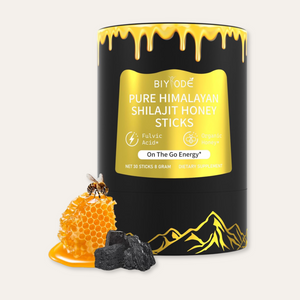
None of this mechanism changes when the resin is blended into raw honey. What changes is adherence. A jar of raw shilajit resin is notoriously sticky, hard to portion precisely, and carries a strong, earthy bitterness that many people find genuinely difficult first thing in the morning. A honey stick solves all three problems at once: it's pre-measured, it's mess-free, and the honey naturally rounds out the flavor. For a supplement whose benefits are described as cumulative over weeks, the format that people will actually take every single day tends to outperform the "purer" format that ends up abandoned in a cupboard after a week.
Altai Shilajit vs. the "Himalayan" Myth: What's the Difference for Energy?
The distinction between authentic Altai shilajit and generic "Himalayan" products marketed online is genuinely important for anyone hoping to see a real effect on fatigue.
Genuine Altai shilajit is harvested at altitudes of roughly 14,000–15,000 ft in the Altai Mountains, a region with a distinct geological and mineral profile. This specific provenance is associated with a unique mineral and DBP composition, which reputable brands verify through independent lab testing (commonly LC-MS/MS analysis). In contrast, many products marketed simply as "Himalayan" shilajit are synthetic fulvic acid powders or lower-quality imitations with unverified origins.
Claims of fulvic acid concentrations around 80% are, for context, considered scientifically implausible for authentic shilajit resin — genuine resin typically contains fulvic acid in a much lower, single-digit-to-mid-teens percentage range. Exaggerated claims like these are a common red flag for counterfeit products that lack the fuller complex of bioactive compounds — DBPs, trace minerals, and genuine fulvic acid — needed to meaningfully support cellular energy. This is exactly why lab transparency matters more than marketing copy when choosing a honey stick brand: ask to see the certificate, not just the claim on the label.
Comparison
|
Factor |
Synthetic Energy Boosters |
Shilajit Honey Stick |
|
Mechanism |
Stimulant-based, temporary |
Mitochondrial support, more sustained energy |
|
Nutrient Profile |
Limited, isolated compounds |
80+ trace minerals, fulvic acid, DBPs |
|
Absorption |
Variable, often lower bioavailability |
Enhanced by fulvic acid |
|
Side Effects |
||
|
Format Friction |
Pill or powder, easy to forget |
Single-serving stick, no prep required |
|
Long-Term Pattern |
Diminishing returns, possible adrenal strain |
Supports cellular health over time |
What Are the Real-World Benefits of Shilajit for Sustained Energy?
Shilajit is generally discussed as offering benefits that go beyond a temporary boost, working instead on the underlying causes of fatigue.
Its adaptogenic properties are thought to help the body manage stress more efficiently, potentially reducing some of the physiological burden that contributes to exhaustion. Consistent use is commonly associated with a more balanced energy state throughout the day, potentially softening the common afternoon crash.
- Improved stamina — A 2009 study on physical fatigue (Bhattacharyya et al.) discussed shilajit's potential to support endurance and reduce recovery time after exercise.
- Enhanced focus — By supporting cellular energy in brain tissue and helping reduce oxidative stress, shilajit is associated with clearer thinking and more sustained mental alertness.
- Better sleep quality — While it's not a sedative, improved cellular energy balance may indirectly support more restorative sleep as the body's systems operate more efficiently overnight.
- Antioxidant support — Fulvic acid and DBP compounds are thought to provide meaningful antioxidant protection, helping safeguard mitochondria from ongoing damage.
These benefits are generally described as accumulating gradually — over roughly 2–3 weeks of consistent daily use — as the body's cellular processes adjust. This is one more reason the honey stick format matters practically: a benefit that takes weeks to show up requires a product people will actually keep taking that whole time, and a stick that lives in a bag or on a desk is far more likely to survive that window than a jar that requires a spoon and a glass of warm water every morning.
Global Context: What the Data Shows
Fatigue and low energy are consistently among the most commonly reported wellness complaints in population health surveys across countries, even in populations with technically "adequate" sleep duration. This pattern echoes a broader theme seen across mitochondrial and stress research: the issue is frequently less about total hours of rest and more about the underlying cellular efficiency of energy production — which is exactly the layer shilajit is discussed in relation to, rather than sleep timing or duration on its own.
Safety, Side Effects, and Who Should Avoid It
Shilajit is generally well-tolerated, but certain individuals should exercise real caution or avoid it entirely, regardless of format.
Potential contraindications include hemochromatosis (excess iron), gout, and phenylketonuria. Pregnant or breastfeeding women, and children under 12, should avoid shilajit due to insufficient research in these populations. It's also worth noting that because the honey stick format contains real honey, anyone closely managing blood sugar should factor that in alongside the shilajit itself.
Global Context: What the Data Shows
Source: Our World in Data — open global research and statistics (CC BY).

Healthy life expectancy — years lived in good health — diverges sharply from total lifespan in many regions. Cellular energy metabolism, including mitochondrial efficiency during sleep, is a foundational driver of the gap between living long and living well. Supporting the overnight ATP recharge cycle is one mechanism that may narrow that gap at the individual level.
Always confirm that the shilajit used is purified and tested for heavy metals — raw or unpurified forms can contain contaminants that undermine the entire point of taking it for health support. Shilajit may also interact with certain medications:
- Blood thinners — consult your doctor before use
- Diabetes medication — shilajit may influence blood glucose regulation
- Blood pressure medication — mineral interactions may affect cardiovascular response
- Immunosuppressants — shilajit's immune-modulating properties could interfere with immunosuppressive therapy
A commonly recommended dosage is in the range of 100–300 mg per day (roughly what a single honey stick is designed to deliver); exceeding this isn't advised and doesn't appear to accelerate results. Dietary supplements are not FDA-approved to diagnose, treat, cure, or prevent any disease. Always consult your healthcare provider before starting any new supplement, especially if you have a pre-existing condition or take prescription medication.

What Shilajit Honey Sticks Cannot Do (Honest Limitations)
While shilajit offers meaningful support for energy and vitality according to the research discussed above, it is not a magic bullet, and being upfront about that is the whole point of an honest article.
It cannot replace prescription medication for diagnosed conditions like chronic fatigue syndrome (CFS) or severe hormonal disorders. It also won't instantly undo years of poor sleep, poor diet, or a sedentary lifestyle — it works best layered on top of a genuinely reasonable baseline of nutrition, movement, and rest, not as a replacement for any of them.
Specific limitations of the honey stick format:
- It's not a stimulant. There's no immediate jolt the way there is with caffeine; the effect is described as gradual and cellular.
- Results take time. Most people report noticeable changes after 2–3 weeks of consistent daily use, not 2–3 days.
- It still carries a mild earthy undertone. Honey softens shilajit's natural bitterness considerably, but doesn't erase it entirely for especially sensitive palates.
- It contains real sugar from honey, which matters for anyone tracking sugar intake or managing a condition like diabetes.
- The market is full of counterfeits. This makes sourcing from a brand with transparent, third-party lab testing more important than the marketing claims on the label.
How Can You Integrate Shilajit Honey Sticks into Your Daily Routine for Energy?
Integrating a shilajit honey stick into your daily routine is about as low-friction as a supplement habit gets.
A single honey stick is generally designed to deliver a dose comparable to a pea-sized (roughly 100–200 mg) portion of resin — no measuring, no mixing required, though you can still stir it into warm water, tea, or milk if you prefer that ritual. The honey itself already handles the palatability problem that keeps many people from sticking with raw resin.
A simple, savable routine:
- Tear the stick open at the perforated edge, once or twice daily as recommended.
- Take it directly, or dissolve it into a warm (not boiling) beverage if you enjoy a slower morning ritual.
- Stay consistent — daily intake over several weeks is what allows the adaptogenic and energy-supporting effects to build.
Chronic fatigue often signals mitochondria running under-resourced. DBP compounds in genuine Altai shilajit are thought to directly support the electron transport chain — your body's core energy-production machinery — and a honey stick is simply the format designed to make that daily support realistic instead of aspirational. If morning brain fog and afternoon crashes are your main concern, look for a brand that can show you real lab results, not just a claim, behind whatever product you choose.
"Shilajit's unique molecular composition, particularly its dibenzo-alpha-pyrones, acts as a potent mitochondrial energizer, directly impacting ATP synthesis and cellular respiration, making it a compelling natural agent for chronic fatigue management." — Dr. S. Ghosal, Phytochemistry Research (2006)
Conclusion: Real Energy Is Built at the Cellular Level, Not Borrowed from a Stimulant
Chronic fatigue is rarely solved by another cup of coffee or an earlier bedtime alone — both can help at the margins, but neither addresses what's actually happening inside a mitochondrion that's under-resourced and oxidatively stressed. The research discussed throughout this piece points to a more foundational explanation: fatigue that persists despite rest is often a signal that the cellular machinery responsible for producing energy needs support, not just more downtime.
Shilajit's proposed value here isn't as a stimulant or a quick fix — it's as a mineral- and DBP-rich complex aimed at that underlying machinery, with fulvic acid acting as the delivery system that helps those compounds actually reach the cells that need them. None of that changes when the resin is packaged into a honey stick. What does change is whether you'll actually take it consistently enough, for the 2–3 weeks it typically takes to notice a difference, to find out if it works for you.
As with any supplement, go in with realistic expectations: it won't replace medical treatment for a diagnosed fatigue-related condition, it won't undo a genuinely poor lifestyle overnight, and it works best as one piece of a broader approach that includes real sleep, real nutrition, and real movement. Choose a brand that publishes third-party lab results for both potency and purity, and check with your healthcare provider first if you're pregnant, managing a health condition, or taking medication — particularly blood thinners, diabetes medication, blood pressure medication, or immunosuppressants.
"'ve been using one stick every morning for two weeks. The honey tastes great, and it's so much easier than measuring shilajit resin. Perfect for busy mornings.
- Researchers, Journal of Neurochemistry, 2023 (PMID 37953684)

- Choosing a selection results in a full page refresh.
- Opens in a new window.