



Shilajit Gummies and Coffee: Do They Work Well Together?
Biyode Research team
Introduction:
For most people, coffee is the first thing that happens in the morning and shilajit — if it's part of the routine at all — comes right alongside it. That raises an obvious question: does it make sense to combine a stimula
it like caffeine with a mineral-and-fulvic-acid resin like shilajit, or are you just layering two different "energy" products on top of each other without much added benefit? This guide looks at how caffeine and shilajit actually work, whether the pairing holds up to scrutiny, and how a shilajit gummy specifically fits into a coffee-drinker's routine.
How Caffeine Actually Produces "Energy"
It's worth starting here, because understanding caffeine's mechanism is what makes the shilajit comparison meaningful rather than just marketing language.
Caffeine works primarily by blocking adenosine receptors in the brain. Adenosine is a neurotransmitter that gradually builds up over the course of your waking hours and signals tiredness — it's part of what makes you feel sleepy as the day goes on. Caffeine doesn't create new energy; it blocks your brain's ability to register the fatigue signal that's already there. A useful way to think about it: caffeine doesn't refuel the tank, it just covers up the low-fuel light.
This explains the well-known downsides of caffeine on its own:
- The crash. Once caffeine clears your system, the adenosine that built up in the meantime floods your receptors at once, often producing a dip that feels worse than the fatigue you started with.
- Cortisol and adrenaline response. Caffeine triggers release of stress hormones, which is part of why it feels stimulating — but relying on this repeatedly, especially at high doses, is generally discussed as a potential contributor to overtaxing the body's stress-response system over time.
- Mineral loss via diuretic effect. Coffee has a mild diuretic effect, increasing urination, which can accelerate loss of water-soluble minerals like magnesium, potassium, and B vitamins — minerals that are themselves involved in genuine cellular energy production.
None of this makes coffee "bad" — moderate caffeine intake is well studied and generally considered safe for most healthy adults. But it does explain why some people are drawn to pairing it with something that addresses the underlying cellular energy question rather than just the alertness question.
Where Shilajit Fits Into That Picture
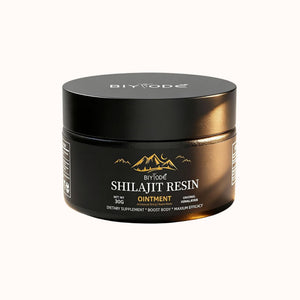
Shilajit is a naturally occurring mineral resin, formed over long periods from decomposed plant matter compressed in high-altitude mountain rock. Its two headline active compounds work through mechanisms distinct from caffeine's:
- Fulvic acid has a chelating property, meaning it can bind minerals and convert them into an ionic form that's more readily absorbed by cells. It's studied both as a mineral-transport agent and for antioxidant activity.
- Dibenzo-α-pyrones (DBPs) are studied for their potential role in supporting the mitochondrial electron transport chain — the process your cells use to generate ATP, the molecule that actually powers cellular activity.
The proposed logic behind combining the two: caffeine addresses the perception of fatigue via the nervous system, while shilajit is aimed at the cellular energy-production machinery itself. In principle, that's a complementary pairing rather than two products competing to do the same thing.
It's worth being precise about the evidence here. The idea that shilajit "smooths out" the caffeine crash, or meaningfully offsets caffeine's mineral-depletion effect, is a plausible mechanistic argument rather than something demonstrated in dedicated, controlled human trials studying the combination specifically. Much of what's cited in this space comes from research on shilajit and caffeine as separate substances, plus general nutrition science about the minerals involved — not head-to-head trials of "coffee alone" versus "coffee plus shilajit." Treat the synergy claim as reasonable and biologically plausible, not as an established, clinically proven effect.

Can Shilajit Help With Coffee's Acidity?
Shilajit is often described as alkaline, with the suggestion that it can help buffer coffee's natural acidity and ease digestive discomfort for people sensitive to it. This is a commonly repeated claim in shilajit marketing, and while the general concept of pairing an alkaline substance with an acidic beverage is chemically reasonable, there isn't strong independent clinical research specifically confirming a meaningful digestive benefit from this particular combination. If you're sensitive to coffee's acidity, this is worth experimenting with personally rather than assuming it as a guaranteed effect — and if digestive discomfort from coffee is a recurring, significant issue, that's worth discussing with a doctor rather than relying on a supplement to solve it.
Why Gummies Instead of Mixing Resin Into Your Cup
The traditional way to combine the two is dissolving a pea-sized amount of shilajit resin (roughly 100–250mg) directly into a warm cup of coffee. This works, but it comes with real friction:
- Taste layering. Shilajit's bitter, earthy flavor combines with coffee's own bitterness — some people enjoy the resulting complexity, but plenty of others find the combination harder to get used to than either on its own.
- Dissolving time. Resin doesn't dissolve instantly, and stirring it into coffee that's too hot or too cool can leave clumps or an uneven mixture.
- Precise dosing is harder in a hot beverage. Measuring a consistent pea-sized amount by eye every morning introduces day-to-day variability.
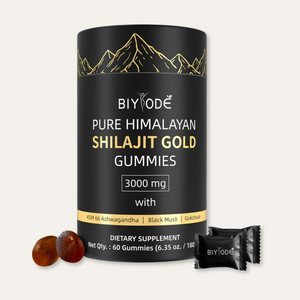
A shilajit gummy sidesteps all of this. You take a standardized, pre-measured dose separately — alongside your coffee rather than mixed into it — with a flavor built to be palatable on its own rather than layered awkwardly with coffee's bitterness. The active compound profile (fulvic acid, DBPs, trace minerals) is the same as what you'd get from dissolving resin into your cup, provided the gummy uses a properly standardized, adequately concentrated extract.
This format also makes the "pairing" more flexible: you're not locked into taking shilajit only when you're drinking coffee, and you can adjust timing (before, during, or after your coffee) without worrying about temperature or dissolving mechanics.
Global Context: What the Data Shows
Source: Our World in Data — open global research and statistics (CC BY).

Healthy life expectancy — years lived in good health — diverges sharply from total lifespan in many regions. Cellular energy metabolism, including mitochondrial efficiency during sleep, is a foundational driver of the gap between living long and living well. Supporting the overnight ATP recharge cycle is one mechanism that may narrow that gap at the individual level.
A Practical Look: Coffee Alone vs. Coffee Plus a Shilajit Gummy
|
Factor |
Coffee Alone |
Coffee + Shilajit Gummy |
|
Primary mechanism |
Blocks adenosine (masks fatigue signal) |
Adds mineral delivery + mitochondrial-support compounds |
|
Energy curve |
Often a sharp rise followed by a crash as caffeine clears |
Some users report the same caffeine profile with less crash intensity — largely anecdotal, not rigorously tested in combination |
|
Mineral impact |
Mild diuretic effect can contribute to mineral loss |
Shilajit's mineral content may help offset this, though not independently confirmed for this specific pairing |
|
Onset timeline |
Immediate (within the caffeine's normal onset window) |
Caffeine's effect is immediate; shilajit's proposed effects build over 2–3 weeks of consistent use |
|
Format convenience |
N/A |
Gummy avoids resin dissolving/measuring hassle |
The honest framing: caffeine's effects are fast and well documented. Shilajit's proposed effects, cellular energy and mineral support, are slower and less definitively proven in this specific combination — so think of the gummy as a separate, complementary daily habit rather than something that will visibly change how your coffee feels on day one.
What to Look for in a Shilajit Gummy If You're Pairing It With Coffee
Quality matters more here than in many supplement categories, given how much low-grade and counterfeit shilajit exists on the market:
- A named, standardized extract with a stated fulvic acid percentage, rather than a vague "shilajit powder" listing.
- Third-party lab testing for heavy metals (lead, arsenic, mercury, cadmium) — shilajit's rock-strata origin makes this a genuine risk in unpurified sources, and testing (ideally from an independent lab) is the only reliable way to confirm safety.
- Transparent sourcing, ideally from a specific documented region such as the Himalayas or Altai Mountains.
- A clean, short ingredient list — extract, natural sweetener, gelling agent, natural flavoring — without a long tail of artificial fillers.
- Reasonable claims. Be cautious of marketing promising an immediate, dramatic transformation in your morning energy; the more grounded claim is a gradual, cumulative effect over weeks.
How to Actually Build This Into a Morning Routine
- Take the gummy alongside your coffee, not necessarily mixed into it — this avoids the taste-layering and dissolving issues of raw resin while still keeping the "morning ritual" pairing many people find satisfying.
- Stick to the labeled serving. Standard doses are generally in the 250–500mg resin-equivalent range; more isn't better, and exceeding the labeled amount doesn't accelerate any potential benefit.
- Give it time. Some people notice a subtle shift within days, but the more meaningful, cumulative effects on baseline energy are generally described as needing 2–3 weeks of consistent daily use — separate from whatever effect your coffee is providing that same morning.
-
Watch your total caffeine intake independently. Shilajit doesn't offset the need to monitor caffeine consumption on its own merits; if you're sensitive to caffeine or drink multiple cups a day, that's a separate consideration from anything shilajit does.

Safety Considerations
- Shilajit itself carries the same safety considerations regardless of whether it's paired with coffee. Individuals with hemochromatosis (iron overload) should avoid it due to its natural iron content. Those with gout should be cautious, since shilajit may affect uric acid levels in some people. It's not recommended during pregnancy or breastfeeding, or for children under 12, due to insufficient safety research in these populations.
- Medication interactions are possible with blood thinners (such as warfarin), diabetes medications (shilajit may affect blood sugar), blood pressure medications, and immunosuppressants — anyone on these should consult a healthcare provider before starting shilajit in any form.
- Caffeine sensitivity is independent of shilajit. If you already experience jitteriness, anxiety, or sleep disruption from coffee, adding shilajit isn't a substitute for adjusting your caffeine intake directly.
- Start with a lower dose to assess tolerance, especially the first time you combine a new supplement with your existing coffee habit.
- Supplements are not FDA-approved to diagnose, treat, cure, or prevent disease. Shilajit gummies are regulated as dietary supplements, meaning specific health claims aren't independently verified by a regulator before the product reaches the market — which is exactly why third-party lab testing and transparent sourcing matter more than persuasive marketing copy.
Conclusion
Coffee and shilajit work through genuinely different mechanisms — one blocks your brain's fatigue signal for a few hours, the other is aimed at supporting the mineral and mitochondrial machinery that produces real cellular energy over a longer timeline. That difference is what makes the pairing a reasonable idea in principle: you're not stacking two versions of the same effect, you're addressing two separate layers of the same underlying "I need more energy" problem.
That said, it's worth keeping expectations calibrated. The specific claims about shilajit smoothing out caffeine's crash, offsetting its mineral depletion, or buffering its acidity are plausible extensions of what's known about each substance individually, not settled findings from trials studying the combination directly. The more solid ground here is shilajit's broader profile — mineral delivery, mitochondrial-support compounds, and a track record of traditional use — not a guarantee about exactly how it will interact with your morning cup.
A shilajit gummy makes this pairing more practical than the traditional method of dissolving resin into a hot cup: no bitter taste layering, no dissolving mess, and a consistent, standardized dose every time. If you want to try it, choose a transparently sourced, third-party-tested product, take it consistently for a few weeks separate from judging your coffee's own effect, keep an eye on your total caffeine intake independently, and check with a healthcare provider first if you're managing a medical condition or taking medication.
" This article is for informational purposes only and is not medical advice. Consult a healthcare provider before starting any new supplement, especially if you are pregnant, breastfeeding, managing a medical condition, or taking medication.
- Researchers, Journal of Neurochemistry, 2023 (PMID 37953684)

Experience the Biyode Difference
Pure, Eurofins-tested Products from the UNESCO-protected Golden Mountains of the Himalayas. 180,000+ customers across 33+ countries trust our quality.
What Our Customers Say on ★Trustpilot
 Verified
2026-07-22
Verified
2026-07-22
Verified
2026-07-22
Verified
2026-07-22
Verified
2026-07-22
Verified
2026-07-22
Frequently Asked Questions About Why 8 Hours of Sleep is Useless if Your Cells Can't Recharge
Will a shilajit gummy actually eliminate my caffeine crash?
Can I take the gummy at the same time as my coffee, or should I space them out?
Does shilajit reduce the jitteriness from caffeine?
Sources
- Clinical evaluation of purified shilajit on testosterone levels in healthy volunteers - Andrologia, 2016
- Heavy metal content and safety assessment of shilajit - Food and Chemical Toxicology, 2009
- Stohs et al. (2021) The role of Dibenzo-alpha-pyrones in bioenergetics and antioxidant activity
These statements have not been evaluated by the Food and Drug Administration. This product is not intended to diagnose, treat, cure, or prevent any disease.