



Shilajit Gummies for Skin: Collagen, Antioxidants, and What the Research Actually Shows
Biyode Research team
Introduction:
Most skincare conversations start and stay on the surface — literally. Creams, serums, and topical treatments dominate the beauty aisle, and for good reason: they're easy to apply and give a visible, if temporary, effect. But skin structure — the collagen and elastin network that determines firmness and elasticity — is built and maintained from the inside, which is where shilajit gummies have entered the beauty conversation as an internal, systemic approach rather than another topical product.
This guide covers what's actually known about shilajit's role in collagen synthesis and skin antioxidant support, what a topical product can and can't do compared to an internal one, and what a realistic timeline for results looks like.
Why Oxidative Stress Matters for Skin Aging
A large share of visible skin aging — fine lines, loss of firmness, dullness — is driven by oxidative stress: damage caused by free radicals, unstable molecules generated by UV exposure, pollution, and normal metabolic processes. Free radicals damage collagen and elastin fibers directly, degrading the structural network that gives skin its firmness and bounce. This is why antioxidants, in general, are a recurring theme across skincare — whether topical (like vitamin C serums) or ingested (like many fruits, vegetables, and certain supplements).
Shilajit's relevance here comes from fulvic acid, its primary bioactive compound, which has documented antioxidant properties — it can help neutralize free radicals by donating electrons to stabilize them before they damage surrounding cellular structures. This isn't a shilajit-specific claim invented for marketing; antioxidant activity in fulvic acid and related humic substances has been studied independently of the skincare context.
What the Collagen Research Actually Shows
This is the area where shilajit's skin-related research is most specific, and it's worth describing precisely:
A randomized controlled trial published in the Journal of Dietary Supplements (Neltner et al., 2024) examined eight weeks of shilajit supplementation and found a significant increase in serum levels of pro-C1α1, a recognized biomarker for Type 1 collagen synthesis. Type 1 collagen is the most abundant collagen type in the human body and the primary structural protein in skin, contributing directly to firmness and resilience — production of it naturally declines with age.
A few things are worth noting about how to interpret this fairly:
- Pro-C1α1 is a biomarker for new collagen synthesis, not a direct visual measure of skin firmness or wrinkle reduction. The study demonstrates that shilajit is associated with the body producing measurably more of the signal for new collagen formation — a meaningful physiological finding, but one step removed from a study that directly measured, say, wrinkle depth or skin elasticity via imaging.
- Eight weeks is the studied timeline. Claims about shilajit's collagen effect should be understood within that window, not assumed to work faster.
- This is one study. It's a well-structured, randomized controlled trial, and a genuinely useful data point, but broader confidence would come from independent replication across additional trials, which is still an emerging area.
A separate line of research adds more context. A 2019 study in the Journal of the American College of Nutrition (Das et al.) looked at gene expression in middle-aged women taking shilajit and found induction of genes related to the extracellular matrix (ECM — the network of proteins, including collagen and elastin, that gives skin its structure) and to microvascular function (small blood vessel health). Improved microvascular gene expression is relevant because better circulation in skin's smallest vessels means more efficient nutrient and oxygen delivery to skin cells, and better clearance of metabolic waste — both of which matter for skin health independent of collagen synthesis specifically.
Together, these two studies point in a consistent direction: shilajit supplementation appears associated with genuine, measurable biological changes relevant to skin structure and support — genes turning on, biomarkers increasing — rather than purely anecdotal claims. That's a meaningfully stronger evidence base than many ingested "beauty" supplements have behind them, even though it stops short of large-scale trials directly measuring wrinkle depth, skin elasticity by instrument, or long-term aging outcomes.

Internal Support vs. Topical Products: Different Jobs
It's worth being clear that shilajit and a topical cream aren't competing for the same job — they work on different parts of the skin and through different mechanisms entirely.
|
Factor |
Topical Collagen Cream |
Shilajit (Internal/Gummies) |
|
Mechanism |
Surface hydration, temporary plumping |
Systemic support for the body's own collagen synthesis |
|
Target layer |
Epidermis (outer layer) |
Dermis and broader tissue, via systemic circulation |
|
Absorption |
Collagen molecules are generally too large to penetrate the dermis |
Fulvic acid supports mineral and nutrient delivery at the cellular level |
|
Core benefit |
Temporary moisture, softened appearance of fine lines |
Supports the body's underlying capacity to produce new collagen |
|
Timeline |
Immediate, but temporary |
Weeks, reflecting the pace of actual biological synthesis |
This isn't an argument that topical products are pointless — moisturizing and protecting the skin barrier (including sunscreen, which remains the single most evidence-backed anti-aging intervention available) matters regardless of what's happening internally. The reasonable framing is that shilajit addresses a different layer of the problem — the body's own collagen-production capacity — rather than replacing topical skincare fundamentals.
Global Context: What the Data Shows
Source: Our World in Data — open global research and statistics (CC BY).

Healthy life expectancy — years lived in good health — diverges sharply from total lifespan in many regions. Cellular energy metabolism, including mitochondrial efficiency during sleep, is a foundational driver of the gap between living long and living well. Supporting the overnight ATP recharge cycle is one mechanism that may narrow that gap at the individual level.
Why Shilajit Gummies Specifically
Shilajit's skin-related research used daily supplementation over several weeks (the collagen trial ran eight weeks), which means consistency of use is central to whether any of this translates into a real effect for an individual. Traditional shilajit resin creates real friction against that consistency:
- Strong, bitter, earthy taste that many first-time users find hard to get past.
- A need to dissolve it in warm water or tea before each use, rather than a quick grab-and-go format.
- Temperature-sensitive texture — hard when cold, soft when warm — that makes handling it more of a small ritual than a simple daily habit.
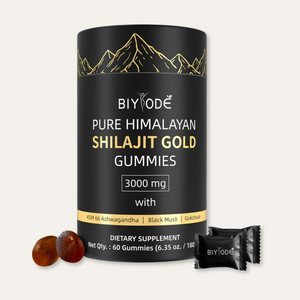
Shilajit gummies remove these barriers directly:
- Standardized, pre-measured dosing every day, without guessing at a pea-sized resin portion.
- Masked bitterness through natural flavoring.
- No prep — no dissolving, no waiting.
The compound profile — fulvic acid and the broader trace mineral complex — is unchanged by format, provided the gummy uses a properly standardized, adequately concentrated shilajit extract rather than a diluted one.
What to Look for in a Shilajit Gummy for Skin Support
Given how much of the shilajit market consists of diluted or counterfeit products — some containing little more than fulvic acid powder or inert mineral waxes like ozokerite sold under generic "shilajit" branding — quality checks matter as much here as anywhere:
- A named, standardized extract with a stated fulvic acid percentage.
- Third-party lab testing for heavy metals (lead, arsenic, mercury, cadmium) — genuinely important given shilajit's rock-strata origin and the contamination risk in unpurified sources.
- Transparent sourcing, ideally naming a specific documented high-altitude region.
- A short, clean ingredient list, without a long tail of artificial additives.
- Realistic marketing claims. Be cautious of language promising visible skin transformation within days — the underlying research points to a multi-week timeline, not an overnight change.
How to Use Shilajit Gummies for Skin Support
- Standard dosing is typically a 250–500mg resin-equivalent serving — check your specific product's label.
- Stick to the recommended dose. Exceeding it doesn't accelerate results and isn't advised.
- Give it a realistic trial period. Based on the existing research, plan on at least 4–8 weeks of consistent daily use before expecting to notice any change.
- Treat it as complementary, not a replacement, for foundational topical skincare — daily sunscreen use remains the most evidence-backed intervention for preventing photoaging, and a hydrating, appropriate topical routine still matters for the outer skin layer regardless of internal collagen support.
Safety Considerations
- Hemochromatosis (iron overload), sickle cell anemia, and thalassemia are conditions where shilajit's natural iron content makes it inappropriate without medical guidance.
- Gout warrants caution, since shilajit may increase uric acid levels in some individuals — check with a doctor before use if you have this condition.
- Not recommended during pregnancy or breastfeeding, or for children under 12, due to insufficient safety research in these populations.
- Medication interactions are a genuine consideration for anyone on diabetes medication, blood pressure medication, or immunosuppressants — shilajit may potentiate the effects of these, so consult a healthcare provider first.
- Supplements are not FDA-approved to diagnose, treat, cure, or prevent disease. Shilajit gummies are regulated as dietary supplements, meaning specific health claims aren't independently verified by a regulator before reaching the market — which is exactly why third-party testing and grounded expectations matter more than persuasive copy.

Conclusion
Skin firmness and elasticity are ultimately a structural question — how much collagen your body is producing, and how well it's holding up against oxidative damage — and that's a question better addressed from the inside than from a jar applied to the surface. Shilajit's case for skin health rests on genuinely specific, if still limited, clinical evidence: a randomized trial showing increased collagen-synthesis biomarkers, and separate gene-expression research pointing to support for the skin's structural network and microvascular function.
That's a stronger evidence foundation than many "beauty from within" supplements can claim, but it's still worth keeping proportionate. These findings demonstrate measurable biological changes associated with shilajit supplementation — they don't yet constitute large-scale proof of visible, dramatic anti-aging transformation, and shilajit should be understood as a complement to solid topical fundamentals (especially daily sun protection) rather than a replacement for them.
Shilajit gummies matter here because the research timeline — weeks of consistent daily use — is exactly the kind of commitment that raw resin's taste and handling make difficult to sustain. A properly sourced, standardized, third-party-tested gummy removes that friction, giving the underlying approach a fair chance to do whatever it's actually capable of doing.
If you're considering shilajit gummies for skin support, choose a transparent, well-tested brand, commit to at least four to eight weeks before judging results, keep your topical skincare routine (including sunscreen) in place alongside it, and check with a healthcare provider first if you're managing a medical condition or taking medication.
"Sleep deprivation significantly alters ATP levels and energy metabolism in neuronal cells, suggesting that the restorative function of sleep is fundamentally tied to mitochondrial bioenergetics rather than simply elapsed rest time."
- Researchers, Journal of Neurochemistry, 2023 (PMID 37953684)
Experience the Biyode Difference
Pure, Eurofins-tested Products from the UNESCO-protected Golden Mountains of the Himalayas. 180,000+ customers across 33+ countries trust our quality.
What Our Customers Say on ★Trustpilot
 Verified
2026-07-04
Verified
2026-06-24
Verified
2026-07-23
Verified
2026-07-04
Verified
2026-06-24
Verified
2026-07-23
Frequently Asked Questions About Why 8 Hours of Sleep is Useless if Your Cells Can't Recharge
Will shilajit gummies definitely raise my testosterone?
Does shilajit reduce the jitteriness from caffeine?
Is a high fulvic acid percentage always better
Sources
- Heavy metal content and safety assessment of shilajit - Food and Chemical Toxicology, 2009
- Effect of shilajit on mitochondrial bioenergetics - Journal of Ethnopharmacology, 2012
- Bhardwaj et al. (2022) Shilajit supplementation and mitochondrial respiratory chain complex activities
These statements have not been evaluated by the Food and Drug Administration. This product is not intended to diagnose, treat, cure, or prevent any disease.