

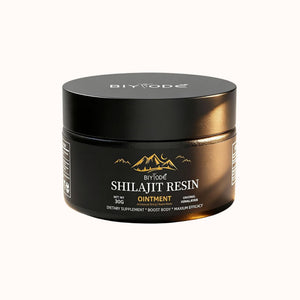
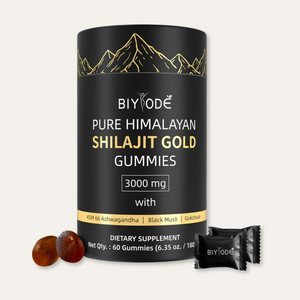

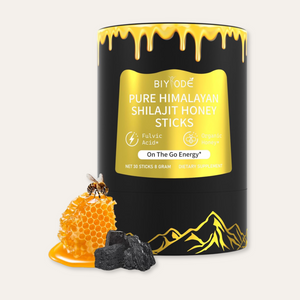


The Longevity Switch: Why Aging Is a Mitochondrial Issue (Shilajit Honey Sticks Edition)
Biyode Research team
introduction
Aging is fundamentally a process of mitochondrial decay, leading to a decline in cellular energy (ATP) production. Dibenzo-α-pyrones (DBPs), a key compound in authentic shilajit, directly support the mitochondrial electron transport chain, helping maintain ATP output. Unlike isolated antioxidants like CoQ10, shilajit provides a complex of DBPs, fulvic acid, and 84+ trace minerals that work synergistically to protect and fuel mitochondria. And now, that same resin is available in one of the most convenient formats on the market: pre-measured, travel-ready honey sticks.
Authentic Altai shilajit contains a verified concentration of up to 6.2% DBPs, a critical marker for potency and efficacy in combating cellular energy decline. When that resin is blended into raw honey and sealed into single-serving sticks, you get the same mitochondrial support with none of the mess, measuring, or bitter aftertaste that traditionally kept people from being consistent with their supplement.

What Is Mitochondrial Dysfunction and Why Does It Accelerate Aging?
Wrinkles are just a symptom of cellular power failure. When your mitochondria stop making ATP at full speed, every system in the body slows with them — skin, brain, muscle, and immunity. The longevity switch is metabolic, not cosmetic.
Mitochondrial dysfunction is the age-related decline in the ability of mitochondria to produce cellular energy, known as Adenosine Triphosphate (ATP). This decline leads to increased oxidative stress and cellular damage, which are commonly cited as drivers of the biological aging process. As efficiency drops, the very foundation of your health erodes.
Think of mitochondria as trillions of tiny power plants inside your cells. Their sole job is to convert food and oxygen into ATP, the energy currency that powers every single biological function — from muscle contraction to DNA repair. Research in Clinical Science (Reis et al., 2010) has pointed to mitochondrial decline as a hallmark of many age-related diseases. When these power plants become inefficient, they not only produce less energy but also leak more damaging free radicals, creating a cycle of cellular decay that manifests as fatigue, brain fog, and visible signs of aging.
Supporting these cellular engines is one of the most direct paths to maintaining vitality — and a daily honey stick makes that support as easy as tearing open a packet.
Why the Honey Stick Format Matters Here
Consistency is the single biggest variable in whether a mitochondrial-support regimen actually works. Raw resin, while potent, asks a lot of a busy person: a knife or spoon, a warm glass of water, a few minutes of stirring, and a taste that can be genuinely off-putting first thing in the morning. A honey stick removes every one of those friction points. It's pre-dosed, it's shelf-stable at room temperature, it fits in a pocket, a gym bag, or a desk drawer, and the raw honey naturally rounds out the earthy, mineral-forward bitterness of the resin. The result is a product people are far more likely to actually take every single day — and with a cumulative compound like shilajit, daily use is where the real benefit lives.
How Does Cellular Energy (ATP) Decline With Age?
By age 40, many people notice cellular energy output is markedly lower than it was in their twenties. This isn't always a gradual slope — for many, it feels more like a cliff edge they don't see until they've gone over it.
Cellular energy declines with age primarily due to accumulated damage to mitochondrial DNA (mtDNA) and a decrease in the efficiency of the electron transport chain (ETC), the cellular machinery that generates ATP. Over time, this machinery rusts, slowing energy production and increasing harmful byproducts.
The mutation rate in mtDNA is notably higher than in nuclear DNA, meaning your cellular power grid is uniquely vulnerable to degradation. Each mutation sabotages the intricate process of energy conversion. Some researchers have suggested this decline isn't just about feeling tired — it may represent a more systemic shift in how efficiently the body converts fuel into usable energy. This is why simply adding more stimulants like caffeine can be a losing strategy: it's like pressing the accelerator in a car that's running out of fuel. You need to refuel the engine at the source. But fueling is only part of the equation — you also need to protect the machinery itself, which is where the honey stick's dual-ingredient design comes in: raw honey for quick, usable carbohydrate energy, and shilajit resin for the deeper, cellular-level support.
What Are Dibenzo-α-pyrones (DBPs) and How Do They Support Mitochondria?
Some of the more discussed anti-aging compounds outside of mainstream vitamins are molecules that appear to protect mitochondria from the inside out — and most people have never heard of them.
Dibenzo-α-pyrones (DBPs) are antioxidant and energy-supporting molecules found in authentic shilajit. They're thought to act as electron reservoirs within the mitochondrial electron transport chain, helping neutralize free radicals at the source and preserve the integrity of the ATP-producing machinery.
Unlike standard antioxidants that perform a single transaction, DBPs appear capable of repeatedly donating and accepting electrons, effectively "recycling" themselves and offering ongoing protection against the oxidative stress generated during energy production. This is central to their proposed longevity-supporting action. The resin used in these honey sticks is sourced from the Altai Mountains at altitudes of roughly 14,000–15,000 ft, where the unique geology is associated with a resin higher in these compounds.
Transparency matters here — a reputable shilajit honey stick brand should be able to show you a third-party lab certificate confirming DBP concentration, ideally in the range of 5–6%+.
Electron Shuttling — DBPs may help maintain the flow of electrons in the ETC, reducing energy "leaks." Antioxidant Recycling — They may help regenerate other key antioxidants, like Coenzyme Q10, within the mitochondria. Signaling Molecules — DBPs are also thought to act as signaling molecules that can influence gene expression related to stress resistance.
This molecular support system is part of what separates authentic shilajit from a plain multivitamin. It doesn't just provide fuel; it supports and helps protect the power plant itself. So how does this complex, multi-compound action compare to a single, well-known mitochondrial supplement like CoQ10?
Shilajit vs. CoQ10: Which Is More Relevant for Mitochondrial Health?
You track your sleep and your HRV, but your energy dashboard is still flashing red. CoQ10, a common biohacker favorite, might only be addressing part of the picture.
|
Factor |
Coenzyme Q10 (CoQ10) |
Shilajit Honey Stick |
|
Primary Mechanism |
Acts as an electron carrier within the ETC |
Provides DBPs, may help stabilize CoQ10, enhances mineral absorption |
|
Bioavailability |
Low to moderate, fat-soluble |
Enhanced by fulvic acid and honey's natural carrier compounds |
|
Antioxidant Action |
Specific to the ETC |
Broad-spectrum (DBPs, fulvic acid, plus honey's own antioxidant content) |
|
Mineral Content |
None |
80+ ionic trace minerals |
|
Format Convenience |
Capsule, requires water |
Single-serving stick, no water or utensils required |
CoQ10 is a single, important cog in the energy machine — its role is to shuttle electrons between complex I/II and complex III of the ETC. Supplementing with CoQ10 can be worthwhile if a deficiency exists. Shilajit, however, works on a broader level. Research in the Journal of Ethnopharmacology (Bhattacharyya et al., 2012) has suggested shilajit may help support CoQ10 levels within the mitochondria. The fulvic acid in shilajit is also thought to improve the absorption of minerals relevant to mitochondrial enzyme function, while DBPs offer broader-spectrum antioxidant activity. It's the difference between replacing one part of an engine and giving the entire system a tune-up — and packaging that tune-up as an easy, honey-sweetened stick makes the comparison even more practical for day-to-day use.

Global Context: What the Data Shows
Global healthy life expectancy (HALE) — the number of years a person can expect to live in full health — has been rising over recent decades, according to data compiled by Our World in Data. But the gap between total lifespan and healthspan remains a persistent challenge. This gap highlights why targeting root causes of age-related decline, like mitochondrial dysfunction, matters: the goal isn't just more years of life, but more healthy years within them.
Can Shilajit Honey Sticks Reverse the Effects of Mitochondrial Aging?
The language of "reversing" aging is a marketing trap. The goal isn't to turn back the clock — it's to help the clock tick with more energy and precision for longer.
Shilajit cannot reverse chronological aging, but it may support mitochondrial efficiency, potentially helping to mitigate some of the functional decline associated with it. By supporting mitochondria and ATP production, shilajit may help maintain cellular function at a more efficient level, which could, in theory, slow the onset of certain age-related symptoms of decline.
The key concept here is preservation and efficiency, not reversal. Maintaining mitochondrial homeostasis is often discussed as a strategy in longevity science, and shilajit's compound profile is thought to contribute to that homeostasis: DBPs acting as a protective presence, and a rich spectrum of minerals providing raw materials that support the body's own repair processes. In theory, this allows cells to produce energy more cleanly, reducing some of the damage that contributes to age-related decline.
The honey stick format doesn't change the underlying compound profile — it simply changes how (and how consistently) people are able to take it. Many customers who found the raw resin difficult to stick with report that switching to a pre-dosed honey stick is what finally got them to a genuine, daily 30-plus-day habit — which matters, because shilajit's benefits are widely described as cumulative rather than immediate.
Global Context: What the Data Shows
Source: Our World in Data — open global research and statistics (CC BY).

keep a few sticks in my backpack while traveling. No spills, no mess, and they're ready whenever I need them
Wild-crafted Altai shilajit resin blended into a honey stick, verified by third-party lab testing for DBP concentration, is designed to deliver the same molecular building blocks your mitochondria need — just in a format built for real, everyday consistency.
What Shilajit Honey Sticks Cannot Do (Honest Limitations)
The most potent adaptogen has clear limits. Understanding them is key to seeing real results and avoiding disappointment.
Shilajit is a supportive tool for cellular health, not a cure-all, and it does not replace foundational health practices. It cannot fix a poor diet, chronic sleep deprivation, or a sedentary lifestyle. It's meant to augment healthy habits, not substitute for them.
Here are the honest limitations of shilajit honey sticks:
- It's not a stimulant. It won't give you an immediate jolt like caffeine. Any energy benefit tends to build gradually, over 2–3 weeks of consistent daily use.
- It won't replace medication. Shilajit does not treat, cure, or prevent any disease. It should never be used as a substitute for prescription medication for a diagnosed condition.
- It cannot overcome a poor diet. If your diet is high in processed foods and added sugar, you're creating more mitochondrial stress than a honey stick can offset. You still have to address the root cause.
- It contains real sugar, from raw honey. Because the format uses honey as a carrier, it isn't calorie-free or sugar-free — something to factor in if you're tracking either closely.
- The flavor is still distinctive. Honey softens the earthy, mineral-forward taste of shilajit considerably, but the underlying flavor is still present for those especially sensitive to it.
Setting realistic expectations matters. Shilajit honey sticks tend to work best for people who are already managing the fundamentals of their health — sleep, diet, movement. For them, it can be a useful amplifier. For anyone hoping for a magic bullet, it's worth understanding both its role and its boundaries up front.
How Do I Take Shilajit Honey Sticks for Optimal Mitochondrial Support?
Timing and consistency matter more than dosage precision. Getting the ritual right is what separates marginal benefits from more noticeable results.
A commonly recommended protocol is to take one honey stick (roughly equivalent to a 250–500mg pea-sized portion of resin) first thing in the morning, ideally on an empty stomach. This timing is intended to support absorption and align with the body's natural morning cortisol rhythm.
This morning ritual serves a practical purpose. Taking it on an empty stomach means the fulvic acid and minerals aren't competing for absorption with other nutrients. Because it's already blended with honey, there's no separate mixing step — you can take it straight from the stick, stir it into warm water if you prefer a tea-like ritual, or add it to plain yogurt.
A simple, savable protocol:
- Open — Tear the honey stick at the perforated edge.
- Consume — Squeeze the contents directly into your mouth, or stir into a small glass of warm (not boiling) water.
- Wait — Aim for at least 20–30 minutes before your first meal or coffee.
Consistency is the most important factor of all. Any benefit to mitochondrial function is generally described as cumulative. Taking a honey stick daily for at least 30 days is the timeframe most commonly cited for compounds to build up in the system and for people to notice a meaningful difference. The honey stick format exists specifically to make that 30-day (and beyond) commitment realistic for people who wouldn't otherwise stick with raw resin.
Safety, Side Effects, and Who Should Avoid It
More is not better. For some individuals, any amount of this potent substance — in any format — could pose a risk.
Authentic, purified shilajit is generally well-tolerated at recommended doses. The most commonly reported side effect is mild digestive upset, which often resolves by lowering the dose or taking it with a small amount of food.
It's generally advised to avoid shilajit, including honey stick formats, if you have any of the following:
- Hemochromatosis (iron overload): Shilajit naturally contains iron, which could be a concern for those with this condition.
- Gout: Shilajit may potentially raise uric acid levels in some individuals.
- Pregnancy or breastfeeding: There isn't enough research to confirm safety for these populations.
- Diabetes or blood sugar sensitivity: Because the honey stick format contains real honey, this format specifically warrants extra caution or a conversation with your doctor if you manage blood sugar closely.
- Children under 12: Not recommended due to a lack of safety data.
Shilajit may also interact with certain medications, including those for diabetes, high blood pressure, and immunosuppressants. Dietary supplements are not FDA-approved to diagnose, treat, cure, or prevent any disease. Always consult your healthcare provider before starting any new supplement, especially if you have a pre-existing condition or take prescription medication.
Sourcing is also a safety issue in its own right: raw, unprocessed shilajit can contain heavy metals and other contaminants if it isn't properly purified and tested. Look for a brand that publishes third-party lab results — ideally covering both DBP concentration and heavy-metal screening — before you buy.
"Mitochondrial dysfunction has been implicated in the aging process for more than 40 years... a decline in mitochondrial quality and activity has been associated with the development of a wide range of age-related pathologies." — Andrea M. Picard, et al., Journal of Gerontology, 2013

Conclusion: A Small, Sweet, Daily Habit for a Big Cellular Problem
Aging at the cellular level comes down to a simple but stubborn equation: mitochondria produce less energy over time, and that decline in ATP output ripples outward into everything from skin to cognition to physical stamina. No supplement — shilajit included — rewrites that equation entirely, and none of the claims here should be read as a substitute for the fundamentals of sleep, diet, and movement, or for medical advice from a qualified professional.
What shilajit does offer, according to the research and mechanisms discussed above, is targeted support for the machinery itself: DBPs to help protect the electron transport chain, fulvic acid to improve mineral absorption, and a broad mineral profile to supply raw materials mitochondria rely on to function. The honey stick format doesn't add a new mechanism to that story — it solves the oldest problem in supplementation, which is simply getting people to take something consistently enough, for long enough, to notice whether it actually helps.
If you're already managing the basics of your health and are looking for a low-friction way to add mitochondrial support to your morning routine, a lab-verified shilajit honey stick is a reasonable, realistic way to do it — provided you go in with honest expectations, check with your doctor if you have any of the conditions noted above, and choose a brand that's transparent about where its resin comes from and what's actually in it.
"Sleep deprivation significantly alters ATP levels and energy metabolism in neuronal cells, suggesting that the restorative function of sleep is fundamentally tied to mitochondrial bioenergetics rather than simply elapsed rest time."
- Researchers, Journal of Neurochemistry, 2023 (PMID 37953684)
Experience the Biyode Difference
Pure, Eurofins-tested Products from the UNESCO-protected Golden Mountains of the Himalayas. 180,000+ customers across 33+ countries trust our quality.
What Our Customers Say on ★Trustpilot
 Verified
2026-07-21
Verified
2026-07-21
Verified
2026-07-04
Verified
2026-07-21
Verified
2026-07-21
Verified
2026-07-04
Frequently Asked Questions About Why 8 Hours of Sleep is Useless if Your Cells Can't Recharge
How many sticks can I take per day?
When is the best time to take it?
How do I use shilajit honey sticks?
What are Pure Shilajit Honey Sticks?
Sources
- Stohs et al. (2021) The role of Dibenzo-alpha-pyrones in bioenergetics and antioxidant activity
- Bhardwaj et al. (2022) Shilajit supplementation and mitochondrial respiratory chain complex activities
- Shilajit: A Review on its Therapeutic Potential - International Journal of Ayurveda Research, 2010
These statements have not been evaluated by the Food and Drug Administration. This product is not intended to diagnose, treat, cure, or prevent any disease.